What Is Astrocartography?
Astrocartography is what happens when your birth chart meets a map of the world. At the moment you were born, every planet stood in a particular relationship to your birthplace — one rising in the east, another setting, another directly overhead, another deep beneath your feet. Had you been born somewhere else at that same moment, those relationships would have been different. Astrocartography takes that idea literally: for each planet, it traces every place on Earth where that planet was exactly rising, setting, culminating or anti-culminating when you arrived. The result is a world map covered in lines — your lines — and astrologers read them as a geography of your chart: where its themes come forward, soften, or change key.
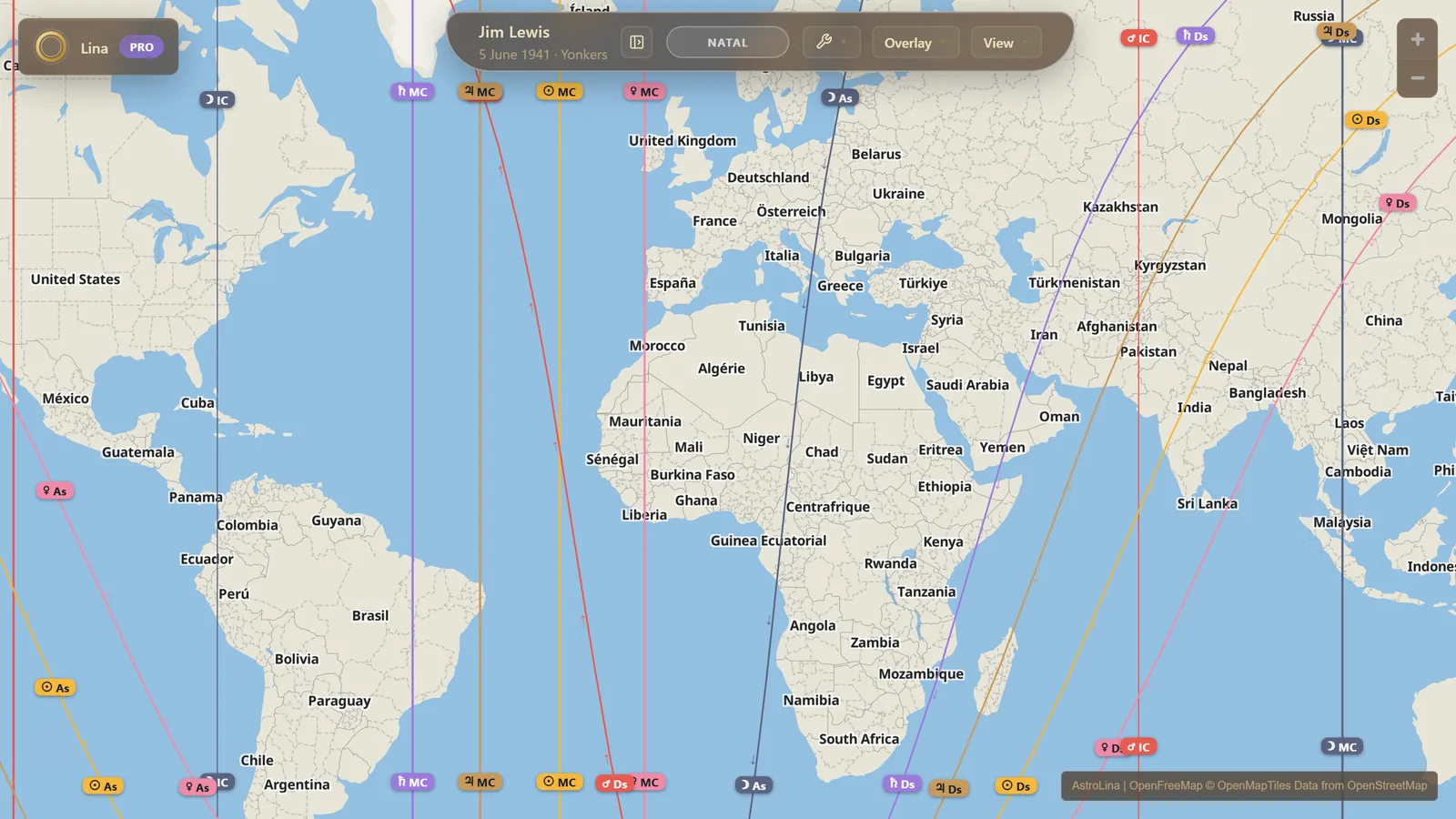
Where astrocartography comes from
Astrologers had long experimented with recasting a birth chart for a new city — a practice called relocation astrology. In the 1970s, the American astrologer Jim Lewis turned the question inside out. Instead of asking "what does my chart look like from Paris?", he computed every place where each planet would sit exactly on an angle, drew the answers as lines across a world map, and called the result Astro*Carto*Graphy. The technique spread beyond its trademarked name and became a field of its own — you'll also hear it called locational astrology. AstroLina is our contribution to that lineage: a modern, open-source planetary map. We launched it on Jim Lewis's birthday, a quiet thank-you to the man who put it on the map.
The four angles: AC, DC, MC and IC
Every line on an astrocartography map pairs a planet with one of the main angles of a chart:
- Ascendant (AC) — the planet was rising on the eastern horizon. These lines colour identity and presence: how you carry yourself, and how a place seems to meet you face to face.
- Descendant (DC) — the planet was setting in the west. The relationship axis: what you look for in others, and what you draw out of them.
- Midheaven (MC) — the planet was culminating, at its highest point in the sky that day. Career, direction, visibility: the version of you a place asks to stand up in public.
- Imum Coeli (IC) — the planet was anti-culminating, at its lowest point that day, deep beneath you. Home, family, roots: the private ground a place offers, and what it stirs underneath.
On a flat map you can tell them apart at a glance: MC and IC lines run straight north–south, while AC and DC lines curve.
What the planetary lines mean
The other half of each pairing is the planet, and each carries its own classical themes:
- Sun — vitality, confidence, being seen
- Moon — comfort, belonging, the emotional weather
- Mercury — conversation, learning, busy minds and quick trips
- Venus — love, beauty, art, pleasure, ease
- Mars — drive, courage, appetite — and friction
- Jupiter — growth, opportunity, generosity, luck
- Saturn — structure, discipline, responsibility, the long game
- Uranus — change, freedom, reinvention, surprise
- Neptune — imagination, dreams, spirituality — and fog
- Pluto — intensity, power, deep transformation
Read the pairing together: a Venus line rising speaks differently than Venus setting, and Saturn on the Midheaven is a different teacher than Saturn on the IC. And a line is not a hairline of fate — its influence is usually read as a band around it, strongest close to the line and fading with distance. AstroLina shades those orb zones on the map so you can see the reach, not just the stroke.
How to read your astrocartography map
You need three things: your birth date, your birth time, and your birthplace. The time matters most — the angles swing about one degree every four minutes, so a rounded-off birth time can nudge your lines by hundreds of kilometres. A birth certificate is the usual place to find the real one.
Then start where your life already is. Look at the places you've lived, the trips that changed you, the city you keep daydreaming about, and notice which lines pass nearby. Working from lived experience teaches you the map's language faster than any list of keywords: you already know what those places felt like — now you can see what the chart says about them. From there, follow your curiosity outward. Where two planets reach angles at the same moment, astrologers also mark a paran — a thin east–west band at that latitude where the pair blend, which AstroLina can draw for you as well. Parans are one of a good many things the map can do beyond the four main lines; the features page has the full list, each tool with the tier it needs.
However far you roam, hold the map lightly. It doesn't issue verdicts; it offers a lens. The most honest way to use it is as a mirror for reflection — a way of asking better questions about places, not a substitute for going and finding out.
Astrocartography and relocation astrology
The two practices are close cousins, and they work best together. A relocated chart re-draws your whole birth chart as if the same moment had happened in a different city: new houses, new angles, same planets. It answers one place, in depth. Astrocartography answers every place at once, in one image — breadth instead of depth. A natural rhythm is to let the map shortlist the world, then let relocated charts interrogate the shortlist. AstroLina draws both, side by side, so the conversation between them stays on one screen — and for the shortlisting half there are tools that rank places for you and read a single spot back in prose.
Map your own lines
Your lines have existed since the moment you were born — you've been living on this map all along. Seeing it costs nothing: AstroLina's core is free, open-source software, it runs in your browser, and you don't need an account to draw your first chart.
Start mapping — it's free See everything the map can do
Still curious about the basics? The FAQ on our home page answers the questions we hear most.